
Earlier this year, I made a successful bid at a clearing house auction for a weathered steamer trunk that, when opened, revealed a breathtaking mass of papers, letters, sketches, and other historical miscellanea.
Tucked among these papers were the well-worn tools of a dedicated traveller: a pair of Ross London 7x42 Prismatic Binoculars, a Corona 3 portable typewriter, and a British Army 1908 Pattern Small Pack Haversack made of rugged canvas.
Upon delving into the archive, I discovered that this trunk was once the property of William James Masters. William served as an Officer in the British Army with the 25th Battalion Royal Fusiliers during the East African Campaign of 1916–1918.
Amidst the trials of the Great War, he found a profound solace in the natural world, becoming a keen amateur naturalist with a particular devotion to the bird life and plant species of Africa.
At just 25 years old, while returning to England by ship after the war, William found himself at a crossroads, pondering what to do following his release from the Army. He realized he had deeply enjoyed his time in Africa—at least during the moments when no one was shooting at him—and resolved to use his annuity of 1,750 pounds a year to travel the world with no fixed itinerary. His mission was simple: to seek out different experiences while pursuing his passion for nature and ornithology.
The most intimate discovery within the trunk was a large collection of letters William wrote to his only sister, Margaret. These letters, spanning nearly two decades from 1920 to 1938, recount his many experiences as he travelled all over the world.
I realized that these dispatches were too significant to remain hidden away. I have decided to transcribe and release one of William’s letters each fortnight, together with two copies of the many sketches he made throughout his journey.
The Officer’s Travels is a work of historical fiction. While the character of William James Masters and his journey are inspired by the era of the early 20th century, any resemblance to actual persons, living or dead, or actual events is purely coincidental.
The sketches are detailed accurate drawings and the sketch notes are accurate.
For $9.00 per month, you can subscribe to receive these dispatches directly by email. Each dispatch will include a letter to his sister as a PDF and two water colour sketches in PNG format all of which you can download and print.
Given the volume of letters and sketches we will not attempt to put them in a chronological order, rather as we open each letter we will email the letter with the sketches so each fortnightly dispatch will be a new ‘surprise”
Join us as we unwrap the "treasure trove" of William James Masters one fortnight at a time.
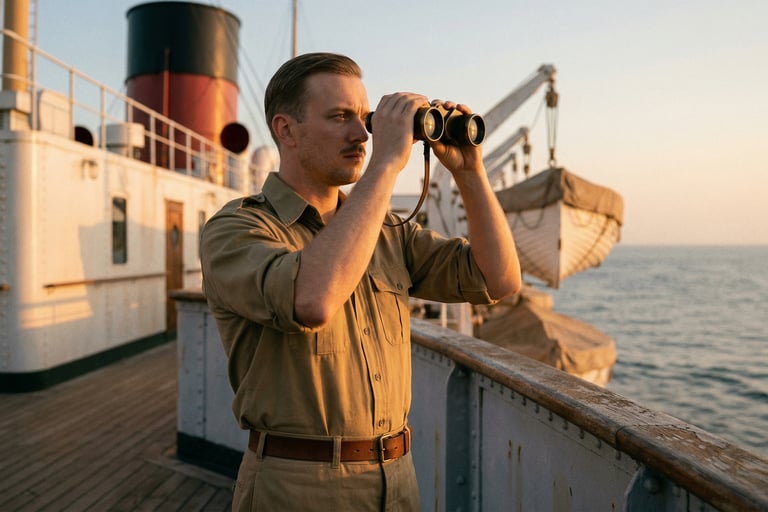
About William James Masters


The Officer's Travels website is owned by Holdbourke Limited NZBN # 9429038955594 © 2025. All rights reserved.
The OFFICER'S TRAVELS is a work of historical fiction. While the character of William James Masters and his journey are inspired by the era of the early 20th century, any resemblance to actual persons, living or dead, or actual events is purely coincidental.